Building the Commercial Operating System for the AI Age
For years, organizations have built specialized operational teams to support growth. Marketing Operations managed campaigns, attribution, and automation. Sales Operations focused on forecasting, territories, and CRM management. Partner Operations handled channel programs and ecosystem reporting. Revenue Operations emerged to connect these functions and create alignment across the customer journey.
Each evolution solved a real problem. But the next evolution is already underway.
Artificial intelligence is forcing organizations to rethink not only how they execute go-to-market strategies, but how they structure the operational teams that support them.
The future may not belong to separate Marketing Operations, Sales Operations, and Partner Operations teams. It may belong to Commercial Operations.
The Problem With Functional Operations
Most organizations didn't intentionally create complexity.
Complexity emerged over time.
A marketing team purchased automation platforms to generate leads.
A sales team implemented CRM processes to improve forecasting.
A channel team deployed partner portals and reporting systems.
Customer success adopted tools to manage retention and expansion.
Each decision made sense independently. We’ve all been there, and it’s worked for us, for many years.
Through the years, collectively, they created fragmented customer data, disconnected processes, competing metrics, and endless debates about ownership. Not to mention duplicate records across systems and data hygiene concerns.
Questions like these became common:
What qualifies as a lead?
Who sourced the opportunity?
Which system contains the correct data?
Why don't marketing and sales reports match?
How should credit be assigned?
As organizations grow, operational teams often spend more time reconciling data than driving business outcomes.
AI Doesn't Care About Organizational Boundaries
Artificial intelligence introduces a new challenge. AI cannot optimize fragmented systems. It requires a connected environment where data, processes, and measurement frameworks work together.
An AI model evaluating growth opportunities doesn't care whether an account originated from:
A marketing campaign
An SDR conversation
A partner referral
A webinar
A chatbot interaction
A customer referral
It evaluates signals. It identifies patterns. It recommends actions.
The effectiveness of AI is directly tied to the quality and consistency of the underlying commercial infrastructure. Organizations with disconnected operational functions will struggle to realize the full value of AI-driven decision making.
Organizations with unified commercial systems will accelerate faster.
The Shift From Functions to Outcomes
Historically, operational teams aligned to departments. The future will likely align operations to business outcomes.
Instead of asking: "How is Marketing performing?" Organizations will increasingly ask: "How efficiently are we creating revenue?" That shift changes everything.
The focus moves away from departmental optimization and toward end-to-end commercial performance.
The customer journey becomes the operating model. Not the org chart.
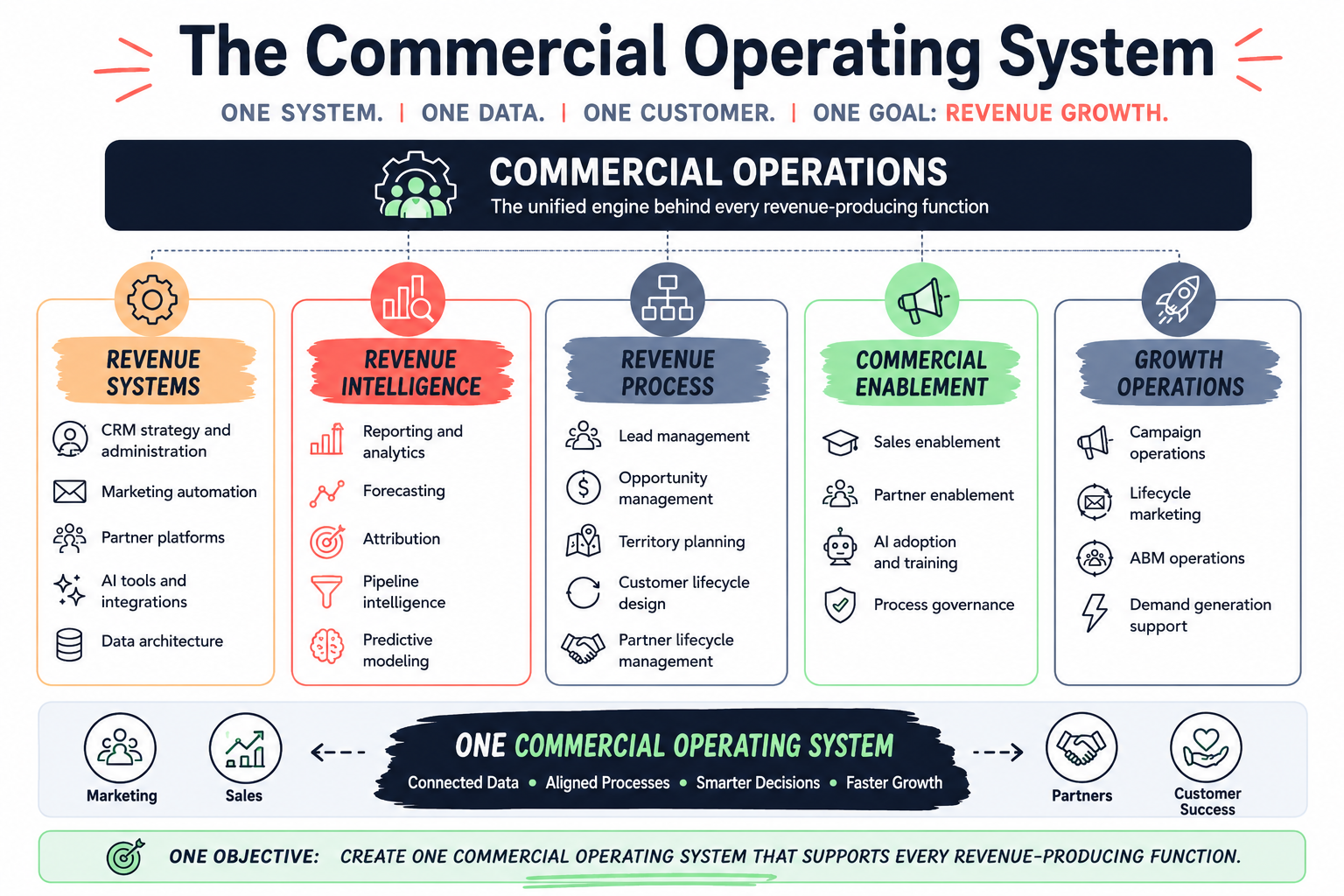
What Commercial Operations Could Look Like
Commercial Operations doesn't eliminate specialized expertise.
Marketing Operations, Sales Operations, Revenue Operations, Enablement, and Systems teams still play critical roles.
The difference is how those capabilities are organized and connected.
Operations Is Becoming Strategic
The most significant change isn't technology. It's the role operations plays inside the business.
For years, operations teams were asked: "What happened?" Today, they're increasingly asked: “Why did it happen?"
Tomorrow, they'll be asked: "What should we do next?" And eventually: "Can the system recommend and execute the next best action automatically?"
That requires a different type of leader and team mindset. One who understands strategy, process, technology, data, finance, organizational design, and increasingly, AI and helps their team unwind the feelings that will follow a change like this.
The Next Competitive Advantage
Every company is investing in AI. They’re all “doing” AI. Not every company is preparing its operating model for AI.
The organizations that win over the next decade won't necessarily have the most sophisticated technology. They'll have the most connected commercial infrastructure.
Because AI is only as powerful as the systems, data, and processes behind it. The future of growth isn't marketing, sales, channel, or customer success operating independently.
It's a connected commercial engine that enables all of them to work as one. The companies building that engine today will be the ones defining the next era of go-to-market performance.
About The Ops Agency
At The Ops Agency, we help organizations align strategy, process, technology, and execution across marketing, sales, and revenue teams. Because growth doesn't happen in silos and in the AI era, neither should operations. Let’s chat!