Layoffs Are the Headline. Organizational Reset Is the Story.
June's layoffs aren't solely about cost cutting. They're about corporate reinvention.
“Thousands cut from tech.” “Hundreds eliminated in healthcare.” “Retail restructuring.” “Financial services consolidating.” “Marketing teams shrinking.” “Operations teams being "streamlined."
The headlines always focus on the same question: "How many jobs were lost?"
But that's the wrong question. The better question is: "What are companies trying to become?"
Don’t get me wrong…it sucks for the people and families impacted, it sucks for the businesses losing loyal, solid teammates, and it sucks the hardworking professionals are seemingly starting from scratch in a craft they have mastered for years. I see you.
The Great Reset Nobody Wants to Talk About
Most organizations spent the last decade optimizing for growth. More people, tools, departments, layers of management, specialized roles…growth at all costs! As long as revenue kept climbing, inefficiencies were tolerated.
Today - that tolerance is gone.
Boards are demanding profitability. Private equity firms are demanding efficiency.
Public markets are rewarding operational discipline.
The result? Companies are no longer asking, "How do we grow faster?" They're asking, "What would this business look like if we built it today?"
That's a radically different conversation. And that conversation needs to start from the top down - if it doesn’t, all of this is for nothing.
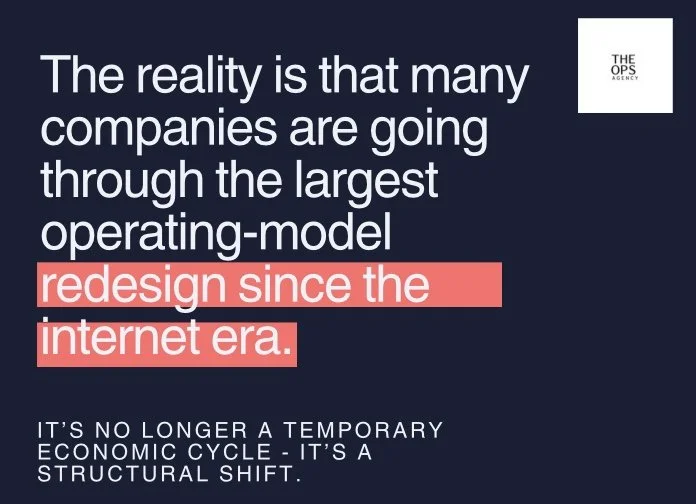
This is as much of an AI conversation as it is a historical shift in the way businesses operate and roles are redefined.
Why Layoffs Are Happening Across Every Industry
Many people assume layoffs signal weakness. Sometimes they do. But increasingly, layoffs are a symptom of transformation. Three major forces are colliding at once.
And for those going through it in right now in the job market - I see you, and this is in no way an attempt to minimizing your experience.
1. Technology Is Compressing Work
Not eliminating work. Compressing it.
Tasks that once required five people can now be completed by two.
Data analysis.
Content creation.
Research.
Reporting.
Customer support.
Software development.
The work still exists. The effort required to complete it has changed. Organizations that fail to adapt become less competitive than those that do. If don’t right, this free’s up time for teams to innovate and work on projects they would have otherwise not been able to accomplish.
If done wrong, its enables people that are lazy, to remain lazy. (yeah - I said it.)
2. Companies Are Rebuilding Around Outcomes
For years, organizations rewarded activity.
More meetings = good
More reports = good
More campaigns = good
More projects = good
Today, smart executives measure against outcomes. Things like revenue, retention, profitability, customer expansion, operational efficiency….
Functions that can't clearly connect to business outcomes are facing increased scrutiny. This isn't just happening in marketing. It's happening everywhere.
This starts at the executive level. If there is misalignment or unclear, loosely defined OBJECTIVES for teams to charge toward, no one wins. You’re back to thinking more of everything = good.
3. Capital Has Become More Expensive
The era of easy money is over. When capital was cheap, growth masked inefficiency. Today, every hire must justify itself the same goes for tools.
Every department must demonstrate impact. Organizations are being forced to make decisions they postponed for years.
The Intention Behind These Layoffs
This is where the conversation gets uncomfortable. Most layoffs are not designed to only save money. At least not primarily. They're designed to buy time.
Time to restructure.
Time to modernize.
Time to automate.
Time to simplify.
Time to refocus.
Executives aren't simply reducing costs. They're trying to redesign their organizations for a future that looks very different from the past and they are trying to build the playbook in real-time.
Let me be clear - I am NOT necessarily justifying this, but stating the reality.
The challenge? Most companies are rebuilding the plane while flying it.
What Happens Next?
The labor market is becoming more complicated. Not weaker. More complicated.
Highly capable professionals are entering the market in unprecedented numbers.
At the same time, organizations are struggling to find people who can navigate ambiguity, transformation, and technology.
The paradox is already visible: Companies are laying off thousands while simultaneously struggling to fill critical roles.
Why? Because they're not replacing the same jobs they eliminated. They're hiring different ones that are more strategic, technical, adaptable, and cross-functional.
The future belongs less to specialists operating in silos and more to builders who can connect people, process, technology, and business outcomes.
The Hidden Opportunity
Periods like this create understandable anxiety. But they also create opportunity. Every major market shift redistributes talent. The professionals who thrive are rarely the ones with the most experience in a specific task.
They're the ones who learn how the game itself is changing. The organizations that emerge stronger won't simply be smaller. They'll be clearer.
Clearer on priorities.
Clearer on accountability.
Clearer on value creation.
And the professionals who emerge stronger won't be the ones who resist change. They'll be the ones who understand what companies are actually trying to build. Because the layoffs dominating today's headlines aren't really about reducing headcount (well, they are, but if you’ve read this far you know where I’m going with this)
They're about redefining how work gets done. Whether companies succeed in that transformation remains to be seen. But one thing is clear:
The future of work isn't being debated anymore. It's being built in real time.